
Program · 12 Weeks
Bigger lifts.Faster 5K.
Twelve weeks to add to your squat, bench and deadlift and run a faster 5K. Six sessions a week, self-paced: four lifting days and three runs. You test all four in week 1 and retest them in week 12.
- Goal
- Bigger lifts, faster 5K
- Schedule
- 12 weeks · 6 sessions / week
- Session length
- 40 to 75 minutes
- Equipment
- A rack with safety pins, a barbell and plates, a bench, and a measured 800 meters
- Level
- Intermediate and up, already squatting, benching and deadlifting
What you'll build
Heavy lifting without giving up the run.
For the athlete who wants a bigger squat, bench and deadlift without giving up the run. You train six days a week: four on the barbell, with three runs built around them.
- 01
Max effort days
Monday and Friday are max effort days: in most weeks you work up to a heavy triple on a squat, deadlift or bench variation, then practice the main lift behind it.
- 02
Speed days
Tuesday and Thursday are speed days: a lighter bar and fast reps on the clock. Do not add weight because it feels light. Bar speed is the training.
- 03
Three runs a week
A tempo run straight after Tuesday's lift, an easy long run on Wednesday, and 800 meter repeats on Saturday. Your 5K sets your running paces: the average pace on your watch is your time trial pace.
The training week
A real week on Big 3 + 5K
Six sessions a week. This is week 1 from the app, the test week, not a marketing mock-up: four tests, each on its own day.
- MonBack Squat test: work up to a true heavy single
- TueSpeed day: Bench Press, light and fast, a new set every minute
- WedLong run: 30 minutes, easy
- ThuDeadlift test: a true heavy single, then speed squats
- FriBench Press test: work up to a true heavy single
- Sat5K time trial
- SunRest day
All 12 weeks are in the app from day one. Run the sessions in order and take the day off. From week 2 the training weeks take over: heavy triples on Monday and Friday, speed work on Tuesday and Thursday, a tempo run straight after Tuesday's lift, an easy long run on Wednesday, and 800 meter repeats on Saturday. Train at your own pace and move to the next week when you are ready.
How it runs
Test, build, check, retest.
Your week 1 numbers run the program. The speed work fills in from your three maxes, and your 5K sets your running paces.
- 01
Weeks 1 to 4: test, then build
Week 1 is a test week: Back Squat on Monday, Deadlift on Thursday, Bench Press on Friday, and a 5K time trial on Saturday. Weeks 2 and 3 bring the first heavy triples, on the Pause Squat, the Rack Pull and the Close-Grip Bench Press, and 800 meter repeats at your time trial pace. Week 4 is a deload.
- 02
Weeks 5 to 8: check, then push
In week 5 you take a heavy single on each lift. Beat your week 1 number and you raise your max in the app that day. If you don't, nothing changes. Weeks 6 and 7 are triples on the Front Squat, the Deficit Deadlift and the Pin Press, and the 800s get 10 seconds a mile faster in weeks 5 to 7. Week 8 is a deload.
- 03
Weeks 9 to 11: check again, then taper
Week 9 is the second heavy single on each lift, and the 800s get 20 seconds a mile faster than your time trial pace in weeks 9 and 10. Week 10 is the last heavy week: the Pause Squat and the Close-Grip Bench Press come back, so you can read them against weeks 2 and 3. Week 11 is a taper, so you show up to the retest fresh.
- 04
Week 12: retest
Same four tests on the same days, so you can see what twelve weeks did.
Who it’s for
Built for real athletes with real lives
The athlete who wants a bigger squat, bench and deadlift without giving up the run. You should already squat, bench and deadlift with sound technique, because week 1 asks for a true heavy single on all three. You should also be able to run three miles without stopping. This is not a beginner program. If you are new to the barbell, start with INDOC.
- Lifters who still want to run
- Chasing a bigger squat, bench and deadlift
- Intermediate and up
- 5K time chasers
What you’ll need
- A rack with safety pins and a pull-up bar
- A barbell, plates and a bench (adjustable helps, flat works)
- A few dumbbells, one or two bands, and a kettlebell or a heavy dumbbell for carries
- A watch or phone for the runs and a measured 800 meters: a track or a GPS loop
Everything is written for a garage: no machines, no sled, no specialty bars. From week 5 you need somewhere to dip (rings, rack bars or two boxes), or you take the push-up option in the notes. In week 7 you stand on a plate or a board for the Deficit Deadlift. One rule: a spotter on every barbell press. No spotter that day, no barbell pressing that day. Do the dumbbell work and come back to it. See the full equipment guide.
Inside the app
Every test, every lift, every run, logged
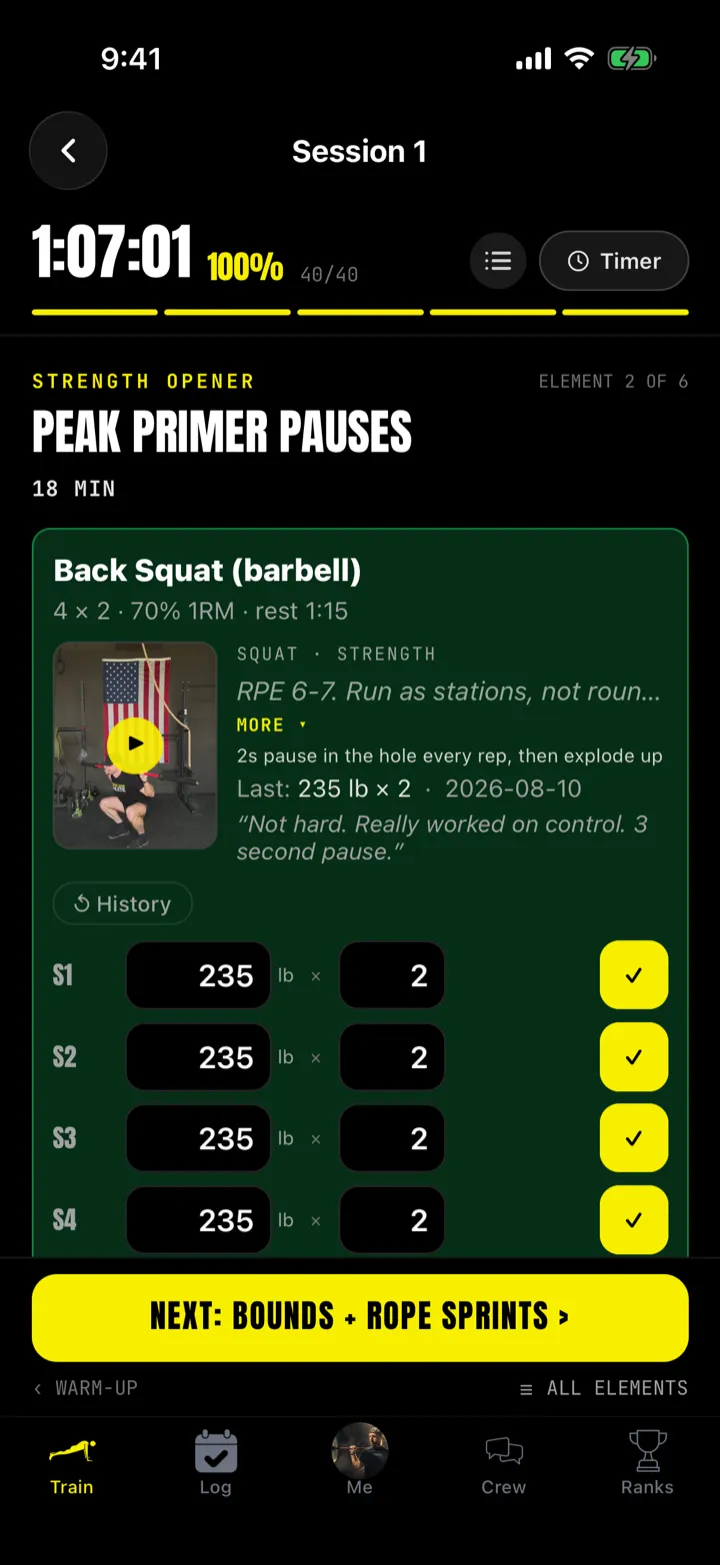
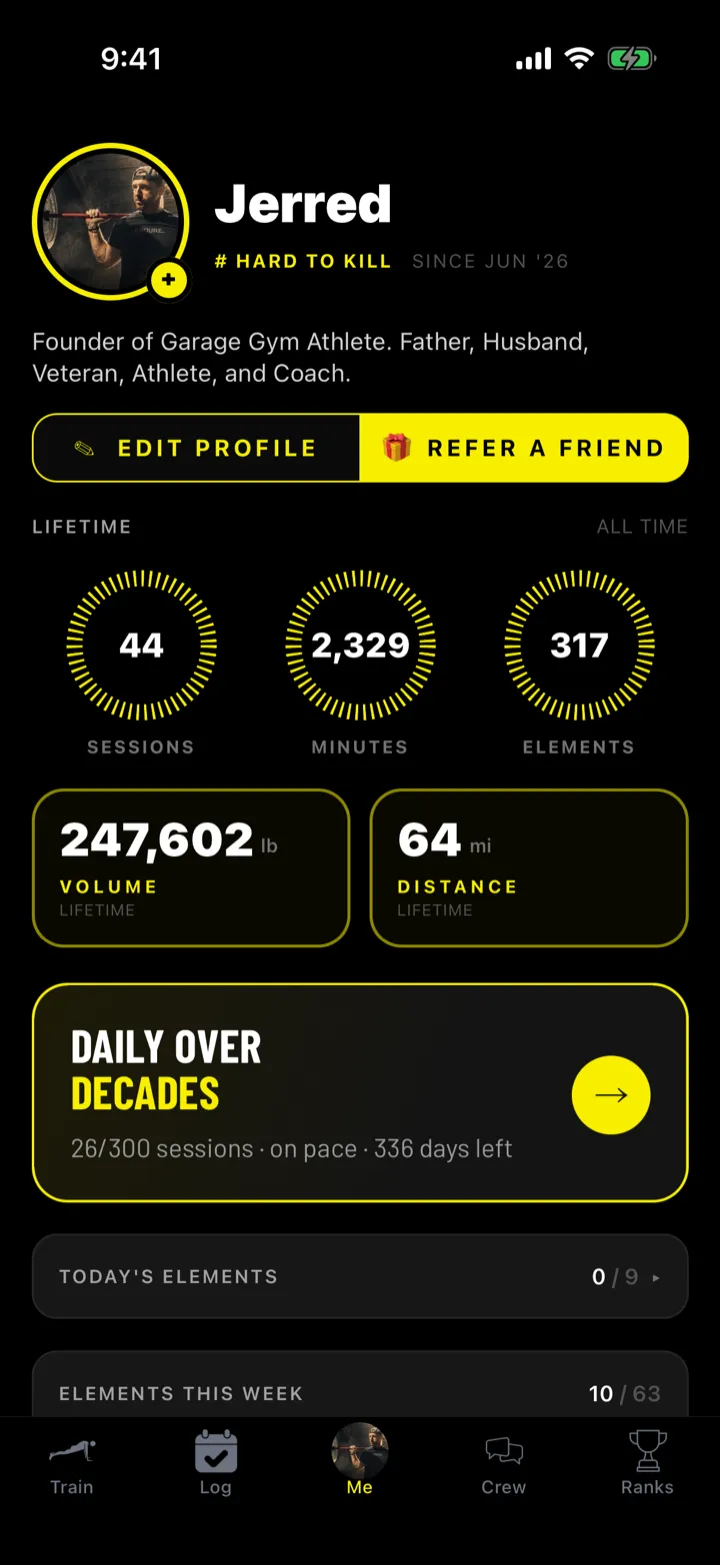
Big 3 + 5K is delivered in the Garage Gym Athlete app, with every block briefed and every number saved.
Your maxes, saved
You test the Back Squat, the Deadlift and the Bench Press in week 1. The app saves your three maxes and fills in the speed work from there.
Raise the max when you earn it
In weeks 5 and 9 you take a heavy single on each lift. Beat your week 1 number and you raise your max in the app that day. If you don't, nothing changes.
Every 800 gets a time
Every 800 meter repeat has its own time to log, so you know the pace is real. Easy runs and tempo runs log the distance you covered.
Log it all
Every lift, every run and every test on iOS, Android, and the web, so you can see what twelve weeks did. Your history comes with you to whatever you run next.
FAQ
Questions, answered
- What are the goals of the program?
- A bigger Back Squat, Bench Press and Deadlift, and a faster 5K, at the same time. You test all four in week 1 and retest them in week 12.
- What equipment will I need?
- A rack with safety pins and a pull-up bar, a barbell and plates, a bench (adjustable helps, flat works), a few dumbbells, one or two bands, and a kettlebell or a heavy dumbbell for carries. A watch or phone for the runs and a measured 800 meters: a track or a GPS loop. From week 5 you need somewhere to dip (rings, rack bars or two boxes), or you take the push-up option in the notes. In week 7 you stand on a plate or a board for the Deficit Deadlift. One rule: a spotter on every barbell press. No spotter that day, no barbell pressing that day. Do the dumbbell work and come back to it.
- What is the skill level required?
- Intermediate and up. You should already squat, bench and deadlift with sound technique, because week 1 asks for a true heavy single on all three. You should also be able to run three miles without stopping. This is not a beginner program. If you are new to the barbell, start with INDOC.
- How do I get the best results?
- Run the sessions in order and take the day off. Be honest in week 1: a sandbagged max makes the program too easy and an ego max makes it impossible. On speed days, do not add weight because it feels light. Bar speed is the training. Keep the easy runs easy, and log every 800 so you know the pace is real.
One membership. All of it.
Every track. Every program. $25/month.
Run Big 3 + 5K start to finish, then land on an ongoing track so there is always a next session waiting. Your history, logs, and maxes come with you.
25,000+ better humans strong
Train like an athlete. Starting today.
Fathers, mothers, veterans, first responders, and busy professionals around the world train with us every day. Your first week is free. Cancel anytime.