6 Proven Methods to Build Strength, Muscle, and Power
The short answer
Getting stronger comes down to three proven principles (maximal, submaximal, and dynamic effort) and 6 methods we program around them: the Money Maker, rest time reduction, max effort, exponential EMOMs, technique work, and lactic acid training. Here's how each one works, with real examples.
Building strength and muscle is incredibly important, regardless of your goals.
But how do you actually get stronger?
Some overcomplicate this answer, while others oversimplify it.
The simple answer...lift weights.
Getting stronger involves continuing to challenge your body, and use of an external load is the best way to do this.
But let’s buckle up today and break this down a little further, to do our best to not leave you with too simple or too complex of an explanation.
To get stronger, you can focus on one (or more) of the following:
- Increase maximal strength
- Increase maximal power
- Increase muscle size
You can work on one of these, or you can work on all three.
Getting stronger does not guarantee you’ll be more powerful or athletic (think powerlifter able to move a big weight slowly)
Building bigger muscles can help with strength, but it certainly doesn’t guarantee it on its own (think bodybuilder that can’t lift very heavy loads or move quickly)
3 tried and true principles to make sure you’re increasing strength and power (and possibly muscle size as well, depending on other genetic factors and goals)
- maximal effort method (lifting a max load)
- submaximal effort method (lifting a load smaller than maximal effort a repeated number of times)
- dynamic effort method (lifting a submaximal load at maximal velocity)
Powerlifters tend to favor maximal effort, to maximize true strength.
Bodybuilders tend to favor submaximal effort, to maximize muscle growth.
Olympic lifters tend to favor dynamic effort, focusing on moving loads extremely fast.
We prefer our athletes to train all 3 over the course of a training cycle (and over the course of the year)
Because this is how…
- You’re best prepared for whatever life throws at you
- You’re more durable and resilient
- You’re ready for wider range of physical challenges
- You’re that guy/girl that just displays fitness everywhere you go…just built differently than those around you
These principles are baked into all of our training cycles across our different training tracks.
These principles are also the foundation of our One Man system, where we take complex methodologies and turn them into a simple protocol you can do at home…with a single barbell, kettlebell, or even your own bodyweight.
For those that ignore the ‘don’t try this at home’ advice, and want to give it a try without our support and attention to detail..
Here are 6 proven methods we use in our programs to build strength:
Money Maker Method
goal: overall strength increase
example: One Man One Barbell week 1, using a max of 210 lb.
4 x 115
4 x 130
4 x 140
4(+) x 160
The (+) means taking that set to as many reps as possible, whether that’s 5 (or 12), followed by regular EMOM work used in our programs to accumulate volume (see next method)
That little (+) makes all the difference in the world.
Rest Time Reduction Method
goal: increased strength and power
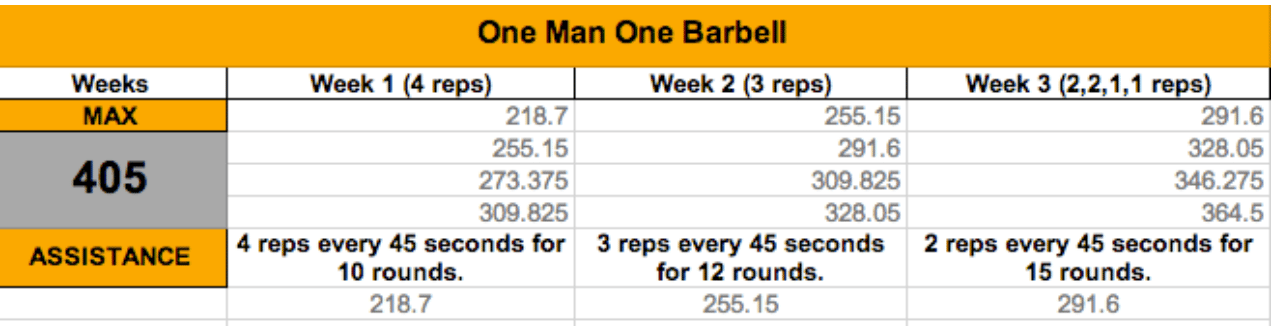
We utilize volume lifting as time based, or every minute on the minute, in many of our programs and our One Man systems. This equates to the lifter being able to handle relatively heavy weights in a specific time domain, which increases the total time under tension, a.k.a under the barbell, for a sizable amount of volume in short time.
Ideally, the lifter would execute the volume work (individual sets/EMOMs) quickly, roughly 10 seconds, leaving around 50 seconds of rest before the next set.
Over time we can reduce this to every 45 seconds, and even 30 seconds, creating an incredible blend of both strength and conditioning
example:
Max Effort Method
goal: increased max strength
The best way to think about this is an extreme focus on operating at max effort.
Before we dive into the specifics, you must know that this method is extremely taxing both mentally, on your CNS, and on your body. It is best done with one cycle followed by a deload week, then another method of One Man One Barbell, before repeating the max-effort-emphasis method.
You have been warned…don’t try to be a superhero.
This method is aimed at gaining the most amount of absolute strength in the shortest amount of time.
example: deadlift max @ 455, using the MaxEffort Emphasis Method:
Work up to a...
3-rep max for week 1
2-rep max for week 2
1-rep max for week 3
Followed by a deload week.
The key here to executing this correctly is to take as many sets as needed to hit true max effort intensity.
Exponential EMOM Method
goal: increased work capacity, strength, and power
The exponential EMOM method is different and very unique.
This method is designed for those who have truly mastered our One Man One Barbell program and for those who need to be able to operate at high intensity (high heart rate) for prolonged periods while maintaining a level head (i.e. CrossFit competitors, first responders, special operators, etc)
example:
5 reps every minute on the minute for 5 minutes @ 50% of 1RM
1-MINUTE REST
3 reps every minute on the minute for 5 minutes @ 55% of 1RM
1-MINUTE REST
2 reps every minute on the minute for 5 minutes @ 60% of 1RM
1-MINUTE REST
1 rep every 30 seconds for 2 minutes @ 70% of 1RM
1-MINUTE REST
1 rep every 30 seconds for 2 minutes @ 75% of 1RM
Technique Method
goal: improved technique, mechanics, and efficiency
Our programs follow a 3 working week and 1 back off (or deload, week). This approach is best for long-term gains and should not be neglected or skipped. This method is another very simple method to help you maintain muscle memory and structured volume in your FOURTH WEEK, or deload week.
Some people really want to keep moving in the fourth week, which is okay…but often they move too much and perform too much volume. Working out in the fourth week is perfectly fine, but volume and perceived effort should be significantly decreased. Without a lack of structure in the fourth week, many feel as if they are wasting their time.
This is not the case, at all.
Your focus in the fourth week should be recovery and technique improvement.
example:
If you have a 300 lb squat you would multiply it by .75 (to get 75%)
A 300 lb. squat during a working week would be turned into 225 lb in a deload week.
So your EMOM would look like this:
Complete four reps every minute on the minute for 10 minutes @ 135 lb
This brings quality work, without the CNS strain.
All good programs that train hard incorporate deloads, and it's about so much more than just taking a week to chill.
Lactic Acid Training Method
goal: increase muscle
We utilize “Lactic Acid Training” sessions; which is a well documented and researched method for building mass, eliciting a hormonal response and inducing fat loss, or rather, high caloric burn.
Doing these sessions correctly is paramount.
Here’s how it works:
Your Target = 35 reps (in this example), so whether it takes you 3 sets or 10 sets you will work till you get to your target reps.
Your rep effort = 5-8 reps, this means on your FIRST set you should choose a weight in which you will be able to get 5-8 explosive fast-moving reps. This is how you will pick your weight used, based off of perceived effort.
Your second set, using the same weight, you may only be able to get 4 reps, and that is perfectly fine.
The rep effort is for that first set.
However, do not be confused by the rep effort. In this example it is not a 5 rep or 8-rep max. It is a weight that you can move VERY QUICKLY for 5-8 reps, not something you can move slowly for 5 reps.
In fact, you may be using a weight you COULD lift 15 times. The weight should be so manageable that you would not need a spotter
Squat Example:
Keeping with our squat example, say I pick 135 lb. for my LAT (Lactic Acid Training) Session.
I would move as explosively as I could with 135 lb., then I realize I am slowing down at 7 reps.
I will immediately stop.
Rest for EXACTLY 30 seconds.
Now, I have 28 reps left.
I will grab 135 lb. again and start squatting, but with fatigue and little rest I may only get 4 reps when I start to slow, so I immediately stop.
Rest for EXACTLY 30 seconds.
Now, I have 24 reps left.
Continue this until you have no more reps to perform.
Properly combining these principles and methods into an easy to follow protocol can transform your strength, fitness, and physique.
And this is just how we structure strength work in our sessions.
Layering in conditioning the right way will make you a whole lot harder to kill.
Try out these methods and principles on your own, or come train with us (by grabbing a 7 day free trial here) to see some of it in action.
Frequently asked questions
What are the three effort methods for building strength?
Maximal effort (lifting a max load), submaximal effort (lifting a smaller load for repeated reps), and dynamic effort (lifting a submaximal load at maximal velocity). Powerlifters, bodybuilders, and Olympic lifters each favor one; we train all three across a cycle.
How often should I train max effort?
Sparingly. Max effort work is extremely taxing on your CNS and body: run one cycle, follow it with a deload week and a different method, then return to it.
What should a deload week look like?
Structured, low-strain technique work at significantly reduced volume and effort, around 75% of working loads. The focus is recovery and movement quality, not proving anything.
Train like an athlete. For life.
Programming built this way: hard when it counts, sustainable the rest of the time.
Related reading